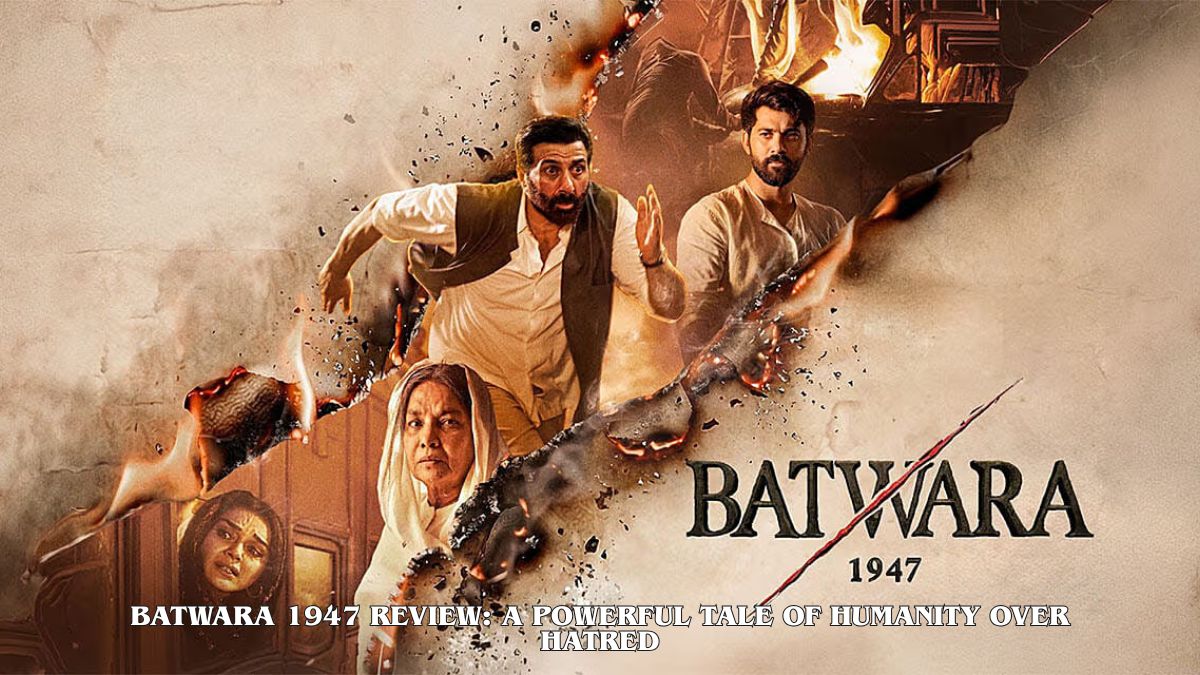
Rajkumar Santoshi and Sunny Deol are back together to bring a deeply emotional saga to the big screen with Batwara 1947. Released on August 14, 2026, just ahead of Independence Day, this film takes on the complex and sensitive theme of the India-Pakistan Partition. Based on a story of resilience, displacement, and human connection, Batwara 1947 aims to strike an emotional chord rather than relying purely on action-packed patriotism.
Produced by Aamir Khan Productions, the film also marks the much-awaited comeback of Preity Zinta to the silver screen, alongside a stellar supporting cast featuring Shabana Azmi, Ali Fazal, and Karan Deol. Does the film live up to the massive expectations? Here’s our complete review of Batwara 1947.
The Plot: A Unique Perspective on the Partition
Set in Lahore during the tumultuous times of 1947, Batwara 1947 steps away from typical cross-border revenge tropes and focuses instead on human relationships. The narrative is reportedly inspired by Asghar Wajahat’s acclaimed play, Jis Lahore Nai Vekhya, O Jamya E Nai.
The story follows Sikandar (Sunny Deol), a Muslim man who moves to Pakistan during the Partition. However, upon claiming his new home in Lahore, he finds an elderly Hindu woman, Mai (Shabana Azmi), who refuses to leave the house she has lived in all her life.
As chaos and violence erupt around them, Sikandar must choose between his prejudices and humanity, ultimately taking on the responsibility of protecting Mai while keeping his own family safe. It is a powerful premise that highlights religious tolerance and the belief that protecting someone else’s faith doesn’t diminish one’s own.
Kal se #Batwara1947 aap sab ki hai. ❤️
Advance bookings are now open on all platforms.
See you at the cinemas tomorrow. 🇮🇳 pic.twitter.com/us68tp6taP— Sunny Deol (@iamsunnydeol) August 13, 2026
Sunny Deol Shines in a Subdued Avatar
Fans flocking to the theaters expecting the aggressive, hand-pump-uprooting Tara Singh from Gadar might be surprised—but in a good way. Sunny Deol delivers one of his most mature performances in recent times.
While his iconic dialogue delivery and roaring voice make an appearance to get the audience cheering, his performance as Sikandar relies heavily on quieter, emotive moments. Early viewers have particularly praised his character arc; Sikandar is not presented as a flawless hero from the get-go.
He makes choices rooted in anger and fear, but his gradual transformation into a compassionate protector is beautifully portrayed. The scenes where he slowly begins to view Mai as his own mother are the emotional highlights of the film.
#OneWordReview…#Batwara1947: POWERFUL.
Rating: ⭐️⭐️⭐️½
The #SunnyDeol – #RajkumarSantoshi combo gets it right yet again… Unconventional plot, strong emotions, power-packed performances are its USPs… Carries a strong, pertinent message. #Batwara1947ReviewBased on… pic.twitter.com/3AR0ONbdgA
— taran adarsh (@taran_adarsh) August 14, 2026
A Stellar Supporting Cast
The film’s emotional core is firmly held together by the phenomenal cast:
- Shabana Azmi: As Mai, she is the soul of the film. Her natural bond with Deol’s character is authentic and never feels forced, providing the film with its most poignant moments.
- Preity Zinta: Returning to the big screen after a decade as Hamida, Zinta proves she hasn’t lost her touch. She lights up the screen and brings depth to the family dynamics.
- Abhimanyu Singh: As the film’s antagonist, Singh is deeply unsettling and compelling, providing the necessary friction to the narrative.
- Ali Fazal & Karan Deol: Both actors bring authenticity and intensity to their respective roles, rounding out a fantastic ensemble.
Direction and Pacing: The Rajkumar Santoshi Touch
Rajkumar Santoshi is known for his hard-hitting dramas, and he brings his signature style of strong emotions and heavy dialogues to Batwara 1947. The background score perfectly complements the emotional beats, especially the scenes of displacement and separation.
However, the film is not without its flaws. The pacing stumbles, particularly in the second half, where some scenes feel stretched. A tighter edit could have elevated the viewing experience. Additionally, while some dialogues deliver genuine goosebumps, the film occasionally relies a bit too heavily on “dialogue-baazi”.
Box Office Clash: Batwara 1947 vs. Awarapan 2
Batwara 1947 faces stiff competition at the box office, clashing with Emraan Hashmi’s highly anticipated Awarapan 2. While Awarapan 2 took a significant lead in advance bookings, grossing around ₹3.25 crore compared to Batwara 1947’s ₹81 lakh, word-of-mouth is expected to play a massive role in the Sunny Deol starrer’s longevity at the ticket windows.
Final Verdict: Is it a Must-Watch?
Batwara 1947 is a deeply sensitive and moving cinematic experience. It bravely chooses to be a film about humanity, compassion, and the resilience of the human spirit during one of history’s darkest chapters. While it has its share of slow moments, the sheer power of the performances—especially the dynamic between Sunny Deol and Shabana Azmi—makes it well worth your time.
If you appreciate emotional family dramas and stories that champion unity over division, this Rajkumar Santoshi directorial is a solid watch for the holiday weekend.
About the Author